Showing posts sorted by relevance for query memetic nexus. Sort by date Show all posts

2016-04-30

模倣子 The Memetic Nexus and the Rock Star

Memetic Index 

It's clear that famous people inhabit what may be termed a "memetic nexus" in which they embody a MIAO which didn't really exist but which provides an attachment site for a collection of memes which can be said to "point towards it" in some sort of n-space elaboration of the memespace.

Examples of this are like stereotypes, although they can be much more subtle. A stereotype is a memetic nexus which an individual may inhabit. A "rock star" type, or a "pundit" or such personage may come to define and elaborate this stereotype, give it more depth and detail, than it had originally.

That's just an observation. At this point I'm not sure it's really true.  And that brings us to one of the several basic questions(1) of memetic systems theory, i.e., is it possible for an individual to escape from a memetic nexus...once it has formed/coälesced around them or pulled them into itself? That's another interesting question: does a memetic nexus "form" around a person or "pull them in"? It's probably a mere question of semantics.

It should be noted here that the memes that surround a memetic nexus are primarily, and perhaps exclusively, contact memes(4). For example, the "classic Native American", a "real, ghetto African American", a "W.A.S.P.", a "disabled person", a "typical politician", a "lesbian or gay", a "science student vs. liberal arts student", a "Frenchman (or other foreigner)", a "nerd or geek", and so on. These kinds of stereotypical identifications are mainly from the perspective of the out-group, probably not from the member(s) of the in-group (or at least that doesn't matter for our discussion).

They may also be faked.

In fact, this kind of fakery is probably the norm for people who find themselves in a memtic nexus. Even nominal in-group members in a memetic nexus within their own group, e.g., a "man's man" or "alpha male", such as a Rock Hudson, a JFK, or an FDR, may actually be pretending to be a great many things which they are not, e.g., sexually attracted to women, physically healthy and vigorous, faithful to a spouse, etc., in order to maintain this situation in the memetic nexus. Or the question becomes, are they forced to, whatever that may mean, that is, how much freedom do they have to leave the nexus, if any? Can a person influence the nexus, the memes that do and do not make it up, effectively (that's really the only was to define it, I think), or are they trapped, able to only enact the memes which make up the nexus? How able are they to participate in memetic hacking(2) vis-à-vis the memes that make up the memetic nexus itself? This may be the influence that drives famous people to "go on a runner", the Rolling Stones(7) to play obscure venues without notice or publicity, etc. It's also compels the individual to pander, that is, to conform the expectations of the out-group's ideology (or memetic make-up) surrounding the in-group, the stereotypes, in order to appear to be a member of said in-group. If one does not wear feathers and buckskins, speak with an affected tone, have "characteristic" ethnic features, espouse certain attitudes, get angry and upset (or enjoy) certain things, and so on and so on, then out-group members are "surprised" or reluctant, even resistant, to accept that one is, in fact, a member of the in-group in question. Of course, one isn't. That is, there is no such in-group, per se, since it is merely a collection of resonant patterns in the memetic fabric of some out-group, which may or may not have anything whatever to do with any real people anywhere, at any point in history.

This may all be researched in the same way as one would any other memetic system analysis(3), and so is not really anything new. It is a phenomenon subject to observation, an historical artifact, so to speak.

The "engineering" project is to ask whether it's possible to a) identify unoccupied memetic nexuses,  b) is there even any such thing as an "unoccupied memetic nexus" (and is this related to a memetic vacuüm?), and c) is it possible to create memetic nexuses, and if so, how? In short, this is a way to figure out how to "get rich and famous" through investigation of the memetic fabric of some chosen population, anywhere from a small group to the entire world, and then do something to insert oneself (or a chosen other or one's products) into that nexus.

Using memetic analysis to identify possible memetic nexuses, and using memetic engineering to insert oneself into it, or even to create one and then insert oneself, is the primary goal of all sales, marketing, and politics. Another question is how to keep oneself outside of a memetic nexus, dissociated from it, and yet still manage to exploit it, while preventing others from doing so. This leave the "outside" individual or organization still free to move in the memespace without the constraints imposed by the nexus. Again, this brings up the question of whether and to what extent a memetic nexus "traps" its occupant and whether they can ever excape. Must the nexus be somehow "destroyed" or "disrupted" or "dismantled" in order to allow such an escape, is that even possible, and what would it look like? Are there any historical examples?

More on this later...


==========================
(1) These questions include: a) "can [dominant] ideologies be changed without violence and the deaths of large numbers of people?", b) "can an individual escape from a memetic nexus?", and c) "are memeplexes (memetic systems) intelligent, do they have goals, can they purposefully adapt to changing environments and competition from other memeplexes in a way that resembles predicting the future?"

(2)Memetic Hacking: Alone, separated from the grand publique, a person may be interrogated, cross-examined, in order to judge their reactions to questions that evince their immunomemes, without the social bullying that keeps them beholden to the memeplex(es) to which they belong. The chosen environment should make them as circumspect as possible to the memeplexes in which they participate, what they perceive as their feelings about it, the nature of their participation, etc. In other words, engage the beholden individual in a meta-memetic exchange.

(3)Memetic Analysis: Identify functional memes from the actions of beholden individuals, identify signal memes from messages, gestures of the beholden, identify MIAOs that attach signal memes (including written matierals, etc.), use thus-far identified memes and MIAOs to evince immunomenes (and identify further MIAOs) through interrogative interactions with beholden both in groups and via memetic hacking.

(4)Contact Meme: A meme that is meaningful to a usually larger outside group, or "out group", to identify and characterize the given "in group" and its members. Examples are racial, ethnic, sexist, classist, and other stereotypes (even "political"), e.g., clothing, behavior, speech (accents, special words, etc.), and actions that characterize a given group. The term derives from the fact that contact memes are significant to out-group members while they may or may not be nearly so significant to in-group members, or eclipsed by much more significant memes that outsiders may be unaware of. It could also be said that contact memes are the memes which outsiders attach to MIAOs universally accompanying in-groups, to which many (negative) stereotypical memes may be attached, but totally different memes (obviously) are attached to the same MIAOs by in-group members. An interesting case might be women's wearing of "provocative" clothing (or the significance of kissing in WWII Britain from the differing standpoints of American servicemen and British women -- an interesting case of intercultural misunderstanding). Other groups may attach memes, typically self-serving ones, to the MIAOs and behaviors (action memes). A woman may attach no especial significance to her wardrobe choices, or she may be trying to evince specific action memes from certain cohorts, i.e., push their members into another memetic state(5)

(5)Memetic State: A condition which characterizes the memetic inventory of a given individual or subgroup based on a given environment, including the memetic signals incident on that environment. For instance, a group of religious or other fanatics (e.g., graduate students) finding themselves in an isolated setting where only in-group members are present. They are now free to discuss specialized subjects, use jargon, and so on and so on, which would alienate, offend, or "give the wrong idea to" outsiders, were they present.  In other words, they are now in a different (nameable) memetic state, where a far greater memetic inventory is available (or just a different one, and such changed memetic states can even lead to things such as a memetic orgy(6).

(6)Memetic Orgy: A subjective distinction where a memetic state is reached such that all or almost all deployed memes resonate with the rest of the cohort, of the memetic fabric. An individual may be driven to escape and seek the society of out-groups for this purpose, or memetic cohorts may try to isolate or even suppress out-group members in order to allow themselves more settings where they can reach a memetic state where the memes deployed therein all achieve maximal resonance. The presence of out-group members in a mass of in-group members act like a "poison" or "neutron absorber" in a nuclear reactor -- many memes to not resonate with them, they do not emit many memes that sustain the highly-reactive, high-resonance state, and may even emit memes and immunomemes that curtail it.

(7)A friend told me how a friend of hers was in a bar with about three other people and the barman in an obscure town in Massachusetts after midnight when The Rolling Stones came out on the little stage and performed for about an hour and then left again. Blue Oyster Cult also performed in a small bar in Roppongi 六本木 one night when I was working there and I'm still kicking myself that I didn't try a little harder to find the place.

2016-07-15

模倣子 Memetic Nexuses and Power

Memetic Index

Is there a relationship between Memetic Nexuses and Power?
I've previously discussed the concept of a memetic nexus, whether it is possible to create them, and will no doubt discuss it further later. I have been trying to come up with a macro-memetic description or definition of "power" for some time now. Of course, one of my big focuses for the past year or so has been to elucidate a set of units of measure for memetic phenomena. Given such a set of units of measure, it should be possible to characterize, among other things, the concept of power, and furthermore, possibly describe with some precision how power works and how to assemble or dismantle it.

And it may also be possible to control power in a non-violent way, which is, by the way, one of the two highest objectives1 of macro-memetics.

Power and Conservatism
A very rough definition of power is "the ability to get things done", but it may be something we can work with. A stable memeplex is conservative in nature, that is, that it has a rich panoply of immunomemes that deter and deflect attacks from any and all sources that seek to change its structure and functioning. This should be perfectly obvious, and is explained thoroughly elsewhere. To recap, however, if a memeplex were not conservative and unable to resist efforts to change it, it would not remain in place, would not remain stable, as we observe to be the case.

This presents us something of a paradox. If memetic systems are conservative, then how do they change and how do they respond to their environments, and thereby survive, among other things, which we also perceive to be the case (although perhaps falsely). This would appear to have bearing upon whether memeplexes enjoy anything resembling "intelligence", by the way. Memeplexes are conservative in nature, and yet they seem to be able to adapt in the short term to "external stimuli" or at least to "change direction" rapidly, all without disintegrating. Governments, religions, institutions all react to events, "threats", countries rouse themselves to go to war, and so on.

 MIAOs, Memetic Nexuses, and Power
 A MIAO is an iconic object to which memes may be anchored. This is the goal of marketing, or more specifically, branding, by the way. We want to avoid having to spend hours explaining to each new person how wonderful our company or product is, or worse, having to re-explain it all to the same person over and over. Another benefit of this anchoring is that it curtails what might be termed memetic drift, i.e., memes drifting in and out of a memeplex (this may or may not be a concept I want to develop later). It can also have other benefits such as carrying some or all of the anchored memes across language and cultural barriers.

A memetic nexus is like a MIAO in that memes may be anchored to it, but it doesn't really exist objectively except as a kind of synechdoche or metonymy in which the referent may or may not actually be there. There is a kind of question along the lines of whether "the presidency" would exist if the office were vacant, or is there "a voice of our generation" if no one person is so acknowledged, or is it attributed to whomever happens to have been speaking?

These may be two different kinds of memetic nexuses, i.e., those that are created before they are filled, as opposed to those which "coälesce organically" around a person or institution. The nature of how nexuses form may be for another discussion. The relationship to the memetic fabric and the memetic inventory of a nexus however, may go a long way toward refining its definition, however.

It occurs to me that the definition of power is that of inhabiting a memetic nexus. For example, "The President" is a memetic nexus (I believe), and its nature is that everyone in the organization, or the memetic cohort, rather, is conditioned, as part of their membership in the memeplex, i.e., the cohort, to somehow "pay attention" to what the President says or does, to one degree or another. It appears that "power" is related to the extent that a memetic nexus occupant (or just a memetic nexus—maybe there's little distinction to be made) influences the members of the cohort.

Memetic Nexuses and Virulence of Generated Memes
We all generate memes all the time. We all receive them. Some of us generate new memes which may or may not resonate with others. What determines this success is:
  1. How easily the the (new) memes are imitated
  2. If they seem likely (in our judgement) to be imitated by others were we to deploy them2
  3. If they "tie into" other memes so as to cause a chain reaction3 for even more reward
This may be a good deal simpler than it seems, and it may be related to why people watch the news, watch sports (or read about them—even more of a dead giveaway), watch the same media, read the same books. The thing about consuming the same media (news, sports, entertainment) is that it happens at the same time everywhere. In other words, discrete packages of memes which are timed on a common "heartbeat" are being pumped into a mega-cohort which consumes them and can then exchange these memes between themselves for a guaranteed and regularly resupplied memetic reward. It's like a drug that gives a new rush each day and which never stops working! Plus, the harder you study, the more the guarantee of the reward. The people who will resonate with your meme are resupplied at the same time as you, so you are guaranteed that they will resonate with what you say, your jokes, and so on. It's always fresh, but it's also always reliable. Having shared culture, such as all having watched Gilligan's Island or the original Dr. Who, or having the same religion (the bible is the same for all), or even having an education, such as French Literature or engineering, provide the same thing, but it's more limited, can grow stale, and even two electrical engineers, one who studied power and the other microelectronics, might quickly exhaust their commonality.

But I go on. What I think I'm driving at is that a memetic nexus, whether it's some organization with a press release organ, or an individual person, may act like a natural time-driven phenomenon like the news, or sports, or the latest show on TV, indeed, the latter may very much resemble what a nexus does, i.e., release memes which everybody receives at the same time, i.e., there is no propagation delay, no damping due to high or low virulence, no mutation, and all members of the cohort receive it no matter the perceived "strength" of the given meme.

A "meme fountain"4 is somebody who generates memes (usually lots of them) with a high degree of virulence. But these memes propagate over time, may mutate considerably, and don't necessarily have a beholden cohort that reliably receives the memes without subjecting them to the above criteria. A memetic nexus would appear to be a special kind of meme fountain, but is there more to it?

We could ask a quick question: is the Pope fundamentally different from an American "televangelist" in terms of whether each is a memetic nexus? Or is it just a question of degree? They function similarly, they each have a sizeable committed or "beholden" cohort. The Pope is selected and placed into a preëxisting memetic nexus, whereas a televangelist's nexus congeals around them and, as often as not, seems to dissipate when the televangelist dies (or is substantively discredited5).

Conclusion...?
It may be that a memetic nexus is a special kind of meme fountain with a "star network" topology of very few jumps to each of the members of a beholden cohort who unquestionably receive (and retransmit) the memes produced by the nexus. The motivation for cohort membership is that since all members of the cohort receive the new memes at the same time and with regularity, they are guaranteed memetic rewards amongst themselves, even to the point of reliable memetic orgies. There may be a "freshness" factor as well, i.e., humans thrive on the learning and imitation of new skills moreso than reënacting old ones over and over.

One intriguing aspect of nexuses and their relationship to power is that they may be one place where the faceless, evolving by Darwinian selection, anthill-like memeplex connects directly with an individual that makes up one of the "lower layers" of its being6. If we can think of human beings as "intelligent" (a doubtful proposition, by the way), then a memetic nexus may be a place where the second replicator can connect with the first, the meme-driven system connecting back to the gene-driven one. This is the kind of thing that's hard to imagine at the next lower level, i.e., the organism sharing some kind of communion with the genes that make it up. But in a certain sense they all communicate with one another. The mythical kind of connection, such as where G-d comes down and speaks to a prophet like a person, with a human voice, is impossible, since memeplexes speak different languages6 than human beings, whose languages in turn are different to those spoken by genes amongst themselves, and genes are made of molecules made of atoms, which have different rules for communicating yet again. But, it's as though a memetic nexus might be a place similar to where a single neuron, or small collection of neurons, has inordinate influence over the behavior of the whole brain, or one gene has huge ramifications for a host organism (or species!), or indeed, a single individual having inordinate influence over their entire people.

So the theory of the memetic nexus may be the key to understanding power within an ideological system (memeplex). We can ask questions which I've asked before: what are memetic nexuses? how do they form? can they be created? how may they be dismantled? what is their nature, or how may they be described in terms of their relationship to the memetic fabric or cohort? do they even really exist?

Some units of measure begin to suggest themselves: the likelihood of a meme being accepted and repeated, a measure of its "virulence", how that is influenced by the given memetic fabric and memetic inventory it is trying to propagate in, and how that all changes when the memes are being generated by a memetic nexus. Mainly, how do we characterize the virulence of a given meme? That might help us to characterize the strength of a memetic nexus, and what other units might we need? Perhaps the number of individuals connected to the nexus, and how strongly?


1To determine if it be possible to change ideological systems without the need for the deaths of large numbers of people, and to answer the question of whether memetic systems (memeplexes) are intelligent.
2Others imitating our memes (or at least reacting to them with other memes) produces a physiological memetic reward (or "memetic orgasm"), which is the motivation, similar to a sex drive or satiety reflex, to deploy memes in the first place.
3This is related to a "memetic orgy", i.e., when almost all memes deployed result in a reaction from most all members of  a sub-cohort.
4c.f., Susan Blackmore, The Meme Machine
5e.g., Jim and Tammy Bakker
6c.f., Gödel, Escher, Bach: An Eternal  Golden Braid

2020-01-27

模倣子 2nd Law of Immunomemetics in Critique Groups

Memetic Index

Introduction
Critique groups degenerate into three different forms, and this may in fact be limited to these three forms, and the reasons appear to be memetic in nature.

1. Cheerleading Squad
2. Sharks and dinner
3. Master and Slaves

Critique Group Dynamics
Moreover, an interesting application of the Second Law of Immunomemetics (1) suggests that so-called "rules" such as "Don't be a dick" don't actually translate into a useful set of corrective behaviors available to group members.

All of the above group dynamics are examples of memetic nexus. In the first two cases, the work and often the author submitting the work are at the center of the nexus, and in the third case the 'master' of the group (2) is the source of the memes for the group.

Why do memetic cohorts tend to resolve into memetic nexuses? Why do critique groups, which tend to start out as 'a circle of friends,' transform into these three archetypes? Again I pose the question: Are these three archetypes a spanning set?

To answer this question, let's take a look at what a memetic nexus is and how it optimally fulfills a basic need of memetic agents, as exemplified by the following law:

The First Law of Memetics

A memetic agent deploys the meme at their disposal most likely to yield optimal resonance.


This could also be termed The Law of Optimal Resonance.

Memetic Nexus and Optimal Resonance
A memetic nexus makes it easier for agents to deploy memes for optimal resonance. How does it do this? A memetic nexus supplies a collection of common memes to its subscribed cohort all at the same time. This results in a cohort who can exchange these memes with each other.

And many of the memes are refreshed on regular intervals. How this novelty effect makes things better may be the topic for another essay.

A negative outcome for an agent is to deploy a meme and get no resonant reaction, i.e., no countermemes deployed in response, i.e., alienation. A slightly less bad outcome is to have oppressive memes deployed in response (3). The author being attacked or praised by the group is the source of these memes, and they are outside the memetic nexus, and they are not a subscriber to it.

By being a subscriber to a memetic nexus, an agent is guaranteed a set of memes which they may deploy in the knowledge that some potentially large group will be able to resonate with them. In fact, there may be simple-to-read cues (8) as to the size of the cohort also subscribed to the nexus. In a critique group which has settled into one of the three archetypes, this population is the entire group.

The Second Law of Memetics
The law states:

Any deployment of a meme moves the cohort to a new memetic state

This could also be termed The Law of State Transition. What does this fairly obvious Law tell us about memetic nexus? In a non-stable cohort, meme deployment moves the group around from state to state, changing the collection of memes available to each person. This is the polar opposite to everybody having a large inventory of memes available to deploy with the confidence that any of them will achieve resonance (5). This is like what exists in a fanatic cell. The optimum is a sizable collection of memes, all available to all members, and deployment of any meme keeps the cohort in the same state (6), or transitioning among a (small) number of states, all interconnected.

This is precisely what a memetic nexus provides to its subscribers. A very desirable and easily achieved memeplex configuration. And as we can see, a critique group tends strongly to converge to that state.

A Prediction
This prediction depends upon ultimately what the definition and nature of immunomemes are. I say that because a 'Sharks and Dinner' group will ultimately do something to their victim author(s) by deployment of oppressive memes (immunomemes) that the group will destabilize. The nature of immunomemes is to prevent destabilization of a memetic system, i.e., a culture. An  author(s) continually bringing their work to the feeding frenzy (4) and being attacked with immunomemes looks like a memeplex trying to defend itself from an outside attack.

This goes along with the First Law of Immunomemetics, which states that any stable memeplex contains an immunomemeplex. So, if the effect of immunomemes on a targeted agent is that said agent gets fewer and fewer memes at their disposal, or they are reduced in status, then ultimately they will be unable to submit work that the group can do anything with. They will die out. Another obvious outcome will be that all authors that submit work will soon find that even if they get the attention of immunomemes directed their way, they will, through the course of this degradation (if indeed this is how immunomemes work) discover that they get more resonance (First Law of Memetics) by subscribing to the nexus instead of submitting work.

Hence, a 'Sharks and Dinner' critique group will tend towards fewer and fewer authors submitting work. This will tend to strangle the memetic nexus, and the group will die out, since members will no longer get the  guaranteed memetic nexus effect they crave. That is, unless the group can transition to a new dynamic.

A stable critique group should converge towards a single author submitting work that is universally praised by the entire group.

Why?

There's an effort minimalization associated with praising only one author, and this is soundly macromemetic in nature. If multiple sycophantic authors exist in a Cheerleading group, then it may be more memes for the group to internalize for little additional resonance benefit. Whichever author is easiest to praise, e.g., has the right mix of complexity and consistency, a difficulty level that fits the lowest common denominator preferences of the group, then that author shall win out over one who is too simple or too complex, who writes too much different stuff in too many different styles, or submits work less regularly, and so on. In fact, regularity may be the critical factor.

Cynical? Of course. But once a group starts to spiral through the process of becoming one of these archetypes, it ceases to be literary and becomes squarely macromemetic.

What about Master and Slaves?
The master may be able to steer the group through a Sharks or a Cheerleaders phase, or even something in between. In which case the group will either die out, or settle into a Cheerleading squad. The master's (or mistress') problem is maintaining the interest of the group, which means maintaining the health of the memetic nexus. Authors submitting work is a very good fuel for this (7). Talking about published authors the master likes, or about writing principles or other things the master has read about will ultimately fall short as they simply don't provide enough interesting memes (9).

In the end, if the master or mistress cannot keep authors submitting work, the group will die. It will either die from the Sharks eating the last of the Dinner (immunomemetic degeneration), or it will collapse into the red dwarf state of one author bringing stuff to the Cheerleading Squad.

Conclusions and Summary
Things look kind of grim. I don't personally know a critique group that works and is stable. Admittedly I don't know many, but these archetypes seem to be a recognized thing.

Intimate intercourse in the form of sharing one's writing and receiving comments about it, especially one is enjoined from saying anything about the comments, is tricky business. I want to write a piece along the lines of 'The Memetic Play and Work of Lovemaking." It's possible to really get hurt, and if the rules are such that it's okay to hurt people and have nobody say anything, and that makes you feel powerful or smart or whatever, or absolves you of having to be asked if those are your motivations, or it plays to your vanity to have people forced to read your work, then people are going to do it and people are going to get hurt.

I feel like those dynamics are present in critique groups and writing groups. It's probably impossible to root them out completely. Critique groups are particularly vulnerable, since there is this intimate interaction that goes on as a part of it. Often it's one-way, as these archetypes show. I've tried to fashion the 12 Steps and 12 Traditions (of AA) for use in Critique Groups. I'll publish these, too.

Meanwhile, I'm trying a little experiment in my writing group to see if I can apply them.

_________________________________________
(1) Any system of rules or laws translates into a collection of bullying behaviors.

(2) and as also happens, a group member 'targeted' by the 'master,' who then becomes the target of the whole group. This may also be by way of selective omission, i.e., the master can allow some members to be targeted and not others.

(3) This is still a work-in-progess. Oppressive memes can result in injury, physical or other, to the oppressed person, or result in a reduction in status, i.e., their inventory of available memes gets reduced, kicking them one step closer to actual alienation. Or it could be memes to which they themselves can't response, or can only make responses which debase themselves. Or it could be other things, or a collection of things. This is all in the search for a clear definition of immunomemes.

(4) A special kind of memetic nexus, where the center of the nexus is attacked with immunomemes. This is the kind of dynamic which exists in racism and sexism, etc.

(5) known as a Memetic Orgy or memetic chain reaction or steady state, depending upon whether the point is to describe intensity or dynamic stability or both. Agents like intensity, and if it may be sustained, much the better.

(6) This does not violate the Second Law -- it simply means that the target state is the current state.

(7) Which is probably why critique groups are such a 'thing.'

(8) Probably the subject of another essay. The obvious maximum is the entire group.

(9) and they're not novel, which may be the appeal of a critique group to start with, and novelty appears to be a critical element of memetic nexus, though I need to explore this further.

2022-03-02

模倣子 Alliances and Nexuses in Chess Model

 Memetic Index - Glossary - Chess Model Article 

Introduction 

We're looking at the good old familiar chess board as a collection of individuals who together decide to make moves. In a human population we see things like memetic nexuses (1) and alliances (2). They learn as a group. The way in which human beings (agents) behave memetically is a psychological question. The way in which our chess pieces behave will be according to some formal model, ultimately arbitrary. The objective will be to try to find some models that seem to work satisfactorily. The next step will be to observe the statistical behavior of actual groups of people and tweak our formal models to more closely track what happens in real life.

In macromemetic theory we have concepts such as residual memetic debt, alliances, immunomemes, and memetic nexuses. We want to have these concepts modeled explicitly in our chess memeplex. In this way we can extract the influence of these structures in our chess model, and then hope to extract them from real life data. If we can identify the agents involved in alliances and nexuses, the memetic debt associated with identifiable meme transactions, and how immunomemes are employed, we can start to quantify these things. The ultimate goal is to have observable phenomena (the deployment of memes, by whom, how, with what frequency) which we can quantify, and laws that that translate those measured quantities into numerical predictions, and furthermore, numerical predictions as to how a system may be controlled by engineered interventions into the system in question.

Notation for Memetic Nexuses 

The idea here is that one piece, say, the queen, expresses a "preference" for a given move, and that this would make it easier or harder for other pieces to "vote" for the same moves. I've hypothesized previously that memetic nexuses are directly related to "power." Alliance behavior also seems to be related to power.  They may be two prongs, or maybe even fundamentally the same thing. I explored notation for chess moves in my previous article on chess notation. 

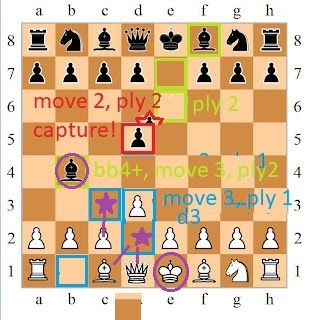
fig. 1. Three Moves to get King out of Check

White has to decide how to get their king out of check. A bad way would be to advance the queen, or the move "WhiteTurn.qd2!" Moving the bishop with "WhiteTurn.bd2!" is at least a little better, with the possibility of an even trade. Finally white can advance the bishop's pawn "WhiteTurn.c3!", which can also lead to a good trade, as well as forcing the bishop to move.

WhiteTurn.[ qd2!, bd2!, c3! ][a1-ap].[ support!, oppose! ] => RelieveCheck

fig. 2. Expression for all possible Moves and piece (agent) "voting"

Let's say the queen "dislikes" sacrificing herself to get out of check. Let's further say that the bishop "likes" the idea of the pawn moving forward. We could try denoting the using immunomemetic notation. 

WhiteTurn.qd2!qd1.dislike! => NoQueenSacrifice
WhiteTurn.c3!bc1.like! => BishopLikesPawn

fig. 3. Queen and Bishop express preferences for two moves

We can think of these as "virtual states" or "hidden states" in that the system does not really "stop" on them and we don't really need to name them explicitly. They are handled by immunomemetic notation. How this can act as a memetic nexus is as follows. Those pieces that are "listening" to the queen (4) can assume that other pieces are listening to the queen as well, and so if they throw their weight behind her "disliking" the "queen sacrifice" move, there will be a lot of support for the move, and that the move will succeed. In other words, they gamble a certain amount of memetic debt, or open a memetic loop, being fairly comfortable that they will get that memetic investment back (3).


(a1)  WhiteTurn.[ qd2!, c3!, bd2! ] [a1 -ap] .[ support!, oppose! ] => MoveChoice
(a2)  WhiteTurn.[ a1 -ap ].[ like!, dislike! ].[a1 -ap].[ support!, oppose! ] => MoveChoice

(b) WhiteTurn.qd2!qd1.dislike![ q, r[a, h]1, n7 ].oppose! => MoveChoice
(c) WhiteTurn.c3!bd2.like![ b[c, f]1 ].support! => MoveChoice

(d1) WhiteTurn.c3![ [a-c, e-h]2, d3 ].oppose! => MoveChoice
(d2) WhiteTurn.c3![ [a-c, e-h]2, d3 ].dislike!
[ [a-c, e-h]2, d3 ].oppose! => MoveChoice

fig. 4. Contrast Nexus-Influenced Versus "Random" Deployment Decisions

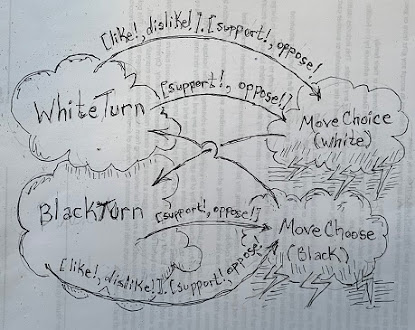
First off, the "MoveChoice" state is a compelled state that the system goes into when all of the "like!/dislike!" and "support!/oppose!" deployments have been made, and some selection method determines which move is actually made (8).  Let's look at figs. 4a1. and 4a2. The difference is that some agent "recommends" a course of action (memetic deployment) prior to other agents having the opportunity to deploy their memes. We see this in the state transition diagram.

fig. 5. State Diagram showing nexus-supported and unsupported transitions

The idea is that we have two parallel memetic pathways, one involving a "like!" or "dislike!" before and the other not. In the figs. 4a., 4b., and 4d2, we can almost see "move!nexus.dislike![ nexus subscription cohort ].oppose!". In other words, we may have found our embedded notation for memetic nexuses, that is, the agents (cohort) who are subscribed to the nexus are indicated in the deployment descriptor, if the individual agent "decides to deploy" the given meme being supported by the nexus.

One thing to note, too, in fig. 4d2., is that all of the pawns are complaining about the pawn being thrown into harm's way. They all protest. In the case of the bishop or the queen, one player is making a case for or against, only one voice being raised, and the others deciding, guessing, whether there's enough charisma to get the measure through or not. In the pawns' case, an onlooker knows how many people are likely to vote for it, since they all complained, deployed a "dislike!". In other words, in fig. 4d2 it's "the mob" and in figs. 4b and 4c, it's the charismatic leader, the demagogue if you will. I will write up one or two ways to actually model this programmatically in the appendix. 

One takeaway is that the meme "agent.support!" is much more "uncertain" than "nexus.like!agent.support!". In the former the agent is taking a wild guess as to whether anybody else will support it, and risking losing the bet and accruing residual memetic debt (the worst outcome for a memetic agent). On the other hand, if the nexus has deployed a polarizing message, then there is a chance that others will rally to the cause, especially if the cohort is large and loyal. Finally, we may be able to enbed the cohort membership in the deployment descriptor in the form of the "list" following the meme deployment following the "like!" or "dislike!". It remains to be seen how well this will work. It's important to remember that these are two different memes, so the perceptions of risks and rewards and even if a given agent considers one or the other to even be in his memetic inventory, are all potentially different.

Implications for Alliances 

With the immunomemetic-style notation, we see how it applies to alliances and now to nexuses. The syntax is very much the same, if not identical. We may not need a separate treatment for alliances in this essay. More may be revealed later, but for now let's look at what we have. For instance, the queen "suggesting" a given move, she is acting as an ally to all of her members (and those who may not be members but who join in on an ad hoc basis (6)).

Conclusion & Summary 

First, it's possible to model a nexus behavior using immunomemetic-style deployment descriptors. Further, it may be possible to embed the nexus subscribing cohort in the deployment descriptor, perhaps in a useful way.

The notation has led us to an interesting relationship between nexuses and alliances, and so may give use a clear idea of how to define, represent, and masure power. As memetic engineers, out goal is exact and relevant measurement, and the application of laws of a quantitative science in order to create (or consoliate) power where it does not exist, or to dismantle it where it does and is being misued, and all without bloodshed, unlike with practically all major power transitions in history.

Further Research 

One area is the loss/gain of status of agents, nexuses, and agents who follow them. This is both whether a meme is chosen for deployment (residual memetic debt). Also there is how well the game is going. How might it work to give all agents a kick (+1 points) if they bet on a successful deployment (or anti-recommendation), and each agent also have a kick up or down if they supported it based on another piece's recommendation. The power of a memetic nexus (or mentor) ultimately stems from how many others continue to follow their deployments.

How useful is our representation of memetic nexus cohorts in immunomementic deployment descriptors? Will it prove unwieldy? Is it easy to read and understand?

Can we look at historical checkmates and back-propagate them in order to train and analyse.

Competition of two societies (opposite colors on the board). For example, central control by queen (or other) versus more democracy, or uncooperative pawns, and so forth.

How can the system "learn" without having to add a lot of notation and behind-the-scenes stuff? Can a memetic nexus lose currency, or the perceived value of their recommendations?

Also, once we have a microcosm going, how can we begin to use it to model real life situations? How to identify these first test groups?

________________

Bibliography

模倣子 State Progression in Chess

Memetic Glossary

________________

Appendix 

Concrete Models of Nexus-Based Deployments 

All possible moves are the memes, but there are only a few moves per turn, and some might be absurd (whether we can judge that at this point is unclear). The first order of business is working out which move gets run. It's arbitrary, and a number of methods could be suggested.

One. The point value of each piece is applied against the "oppose!" or "support!" memes, add them up as I suggest in the previous essay.  Another would simply be to count the number of deployments, one piece, one vote.

The next thing, once the memes are selected, is to list the winners and the losers and decide how to reward or punish them. This is a memetic loop, residual memetic debt kind of concept. Each piece makes an investment, a bet, and if they win or lose (based on the previous considerations), what happens? This could be thought of as the "selection function" in genetic algorithm design.

With a memetic nexus, it's a mix of things. If you have a setback, it might not always be easy to say for certain that it was your faith in your memetic nexus' memes that was the culprit. Plus, there tends to be a lot of collateral emotional investment (which is probably directly related to residual memetic debt, by th way), but that' shouldn't be an issue in our early stages here.

At the end of the day, it comes down to the difference between the likelihood of deploying "agent.meme!" and "nexus.bias!agent.meme!". If the agent sees no great difference in the risk reward of these two memes, then his faith in the nexus has either not developed yet or has collapsed under the weight of a series of failures (7).

How do we model this?

One simple way is that if a given piece consistently gets her suggestions passed is attractive.

More on this later!

________________

Footnotes

(1) Memetic nexus refers to a central agent connected to a collection of other agents via a "short jump" wherein the cental agent pumps out memes to all of them simultaneously. I have not yet put together a good notational description for this, but I think the same immunomemetic notation may serve well.

(2) An alliance is a configuration where a benefactor (or mentor) deploys memes which enable a beneficiary (or protegee) to deploy memes they would not otherwise be able to do (score a goal, secure a job interview, etc.). I use the same notation for alliance interactions as for immunomemetic exchanges. This makes a certain sense since immunomemetic memes and alliance memes alike serve to modify the effect of one meme to produce a different state from the one "intended." For example, "State1.protegee.run-downfield!mentor.pass-ball! => PassComplete" or "State2.mentor.block!protegee.score! => MadeGoal" or "State3.agent.try!enemy.block! => Blocked!"

(3) Memetic debt is "incurred" by deploying a meme, which opens a memetic loop. The loop is closed when the expected resonance to the deployed meme actually happens, for example, the group decision one supported is taken, the audience laughs at one's joke, and so on. An open question is whether there is additional memetic reward associated with the resonance success. This is almost certainly true, and needs to be accounted for, and this is going to be critical to quantitative memetic engineering down the track. For now we make arbitrary decisions in our model. There is also the idea of an agent losing status, so the weight of their liking/disliking and even the success of a group deployment diminishes (or grows).

(4) One aspect of a memetic nexus which is not contained by this simple notation is the idea of agents "subscribing" to the nexus. All we see is that the queen "likes" something, and this potentially influences the choices of the other agents. This isn't like an ally, where a new state is created (potentally a hidden one) that enables the protegee or benefactor to get to a new state that would be impossible otherwise. This nexus notation (which is the same notation) just expresses that a meme was deployed by the center of the nexus, but does not tell us which agents are going to respond. This would be some behind-the-scenes matrix or such, possibly with weights, possibly with each agent having some kind of internal state, possibly resembling a memeplex itself. Anyway, what we want is that if the queen (or the bishop) deploys a "like!/dislike!" meme, it signals that the following memes in the deployment descriptor might be a better-than-average choice. Another factor is feedback as to the record of successes garnered by subscribing to a given nexus. If it continues to go well, it might become more and more attractive somehow, which is what we would expect from our model.

(5) This final move selection method may be highly contrived for now. I may write up some ideas in the appendix.

(6) I have never stipulated that a memetic nexus cohort has to be a definite list, or that it cannot be fluid. The key feature is that agents who consume the nexus' memes and then use them with other members of the nexus are effectively members. If the queen recommends a move, she is doing the same thing, that is, making a given meme appealing for a large number of agents. So we see through this new notation for nexuses that alliances and nexuses are potentially very similar, if not identical, and so their both having a relationship to the memetic definition of power may be vendicated.

(7) What about an agent's overall assesment of how the game is going, and linking that to the performance of nexuses. Some kind of more sophisticated approach would be needed, but what? It may be pretty arbitrary. We're looking for group behavior coming from following of simple memetic rules and a clear notation to discuss then. It may well be that pieces could have their own, different criteria for how well it's going. Crazy example: the pawns, in addtion to tracking successful deployment decisions, could also worry about how many pawns have been killed off over time. For instance, if they're followed the queen's advice for a series of moves, the moves have been accepted (closing memeic loops), but half the pawns have been captured over that time, and they don't like that, so they start to ignore the queen.