Manga Index -- This Whole Comic
These images shrunk down from 600dpi scan, hopefully better

New York Time Article
A.I./REAL LIFE
No-Code’ Brings the Power of A.I. to the Masses
A growing number of new products allow anyone to apply artificial intelligence without having to write a line of computer code. Proponents believe the “no-code” movement will change the world.
By Craig S. Smith
March 15, 2022
The adults I grew up with had to write machine code to made the disk drives they just got out of the crates from IBM, for example. For my entire career up through the mid-nineties, you had to know hundreds of typed commands to get anything done. That started to change with the Macintosh (my dad coined “the Macintosh Test” as whether you could switch the machine on and the next thing you saw was a pictograph shaped like a typewriter).
It started to change on a large scale with Windows95 and 98, but the ability to process Japanese seamlessly didn’t come until much later.
My friend/boss Allan and I half-lamented WindowsNT, which allowed one to actually do a lot of system admin tasks through a point-and-click interface. Basically, it enabled people who didn’t know what the fuck they were doing and didn’t understand the concepts or how the underlying commands worked could accomplish real tasks.
Smartphones are this on steroids, of course.
Having said all that, IBM tried to accomplish what WindowsNT did in the early 90s on a Unix workstation with AIX, which was widely regarded as a disaster. “I no longer fear Hell—I administer AIX.” I always though the name was apt—“AIIIIIIIIIIIIIX!!!”
I also used an ALOE for Pascal at Carnegie Mellon in 1985. “A Language-Oriented Editor” which made it impossible to make syntax errors, the most low-level and agonizing aspect of coding.
That GitHub Copilot thing sounds great 👍🏻 I find Git to be infuriating.
So nothing new in the “no code” department. I think that once any technology (remember hand-cranked cars? 🚗) reaches a certain level of maturity and the possibility of mass appeal looms large, “parameterizing the user interface” becomes the next step.
The fact that it’s finally happening for “AI” (pattern recognition and data-mining, more like) is interesting.
One huge breakthrough was menus back in the mid-80s, or a bit before. The impact is hard to overstate. Just a simple menu instead of hundreds of memorized commands (CLI). At the time I had to write my own menu systems, including mouse 🐁 interactions.
All those things we take for granted, going from CLU to GUI and having actual X-Windows and MS-Windows libraries to work from, changed everything, but it’s all just another layer on top of the same old stuff.
Did you ever wonder why a personal driver is called a “chauffeur”? 🚗 🔥
I don’t know, but “chauffer” means “to heat up”. So I can’t help thinking it was mainly about getting the car started and getting/keeping it warmed up. Which suggests how cars used to work rather differently one upon a time.
Just like in a generation or two hence, people will not wonder why we “dial” a phone 📞 Even though there will be no living memory of that making sense. So it is with technology, I think.
Do we still “sign on” or “log on” to our smartphones?
Road rage article
Article on Cyber Warfare
Demoralizing the Russian people is totally 💯 possible. Attack the electrical grid, gas and oil pipelines, communication networks (including military).
It’s a lot easier to hack a bank 🏦 if you’re not actually trying to steal anything (99% of it is getting the falsified funds out, and securely — see the movie Ghost 👻 for example).
The disinformation side is interesting. One campaign they’re already doing is uploading information about Russian casualties, including pictures. Imagine if Anonymous could get ahold of lists of Russian soldiers deployed here and there, maybe with pictures, and post that large numbers of them had been killed or seriously wounded. The Russian people would go nuts 🥜, especially since the Russian government always tried to hide these numbers.
A standard part of the Swiss 🇨🇭 public defense tactic is to repeatedly announce 📣 “any messages that the government of Switzerland 🇨🇭 has surrendered should be treated as LIES. Keep fighting. Switzerland 🇨🇭 will never give up.” The obvious takeaway is that undermining public and military morale by propaganda that the government or general staff have lost heart 💜 is standard tactic.
*** Two generals are lost so far
“Lost” as in died or as in dropped out?
With modern sound and video editing technology one could create a flurry of videos in which Putin made surrender-sounding messages, or bat 🦇 shit 💩 crazy speeches. The Japanese have already done this.
*** Hmmm lead to WW III ?
It depends on how you define it. Nuclear could conflict probably counts. We already have all of Europe 🇪🇺, the USA 🇺🇸 , Canada 🇨🇦 Ukraine 🇺🇦 Russia 🇷🇺 half the republics of the former Soviet Union involved. China 🇨🇳 may get in, or start their own thing (like Japan 🇯🇵 did in WWII). Who knows? if things get nuclear, India 🇮🇳 may decide to invade Pakistan 🇵🇰 and then China 🇨🇳 might decide to get in on that.
In the 1980s, WWIII was described as a “come as you are war.” 👔 👖 👞 👠 👗 Each belligerent would bring what 🚀 weapons ✈️ and preparedness they had, with no revving up of their war machines as in the first two world 🌎 wars.
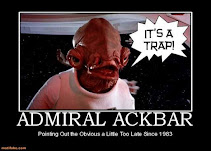
Yes, we cannot leave out the chance that Putin will pull an Emperor Palpatine in Episode Six: The Return of the Jedi and suck us all into “It’s a 🪤 Trap!”.
VERY CREATIVE AND ENTERTAINING ......It is obvious that = as DJT says - Putin is a genius....That Harry J. Kazianis guy really laid out an hysterical catastrophizing screed, eh? Not really saying much. Yes, pictures of blown up buildings and dead people from World War Two, there’s such a thing as nuclear weapons, yeah, we know that. That’s all happened in human history.Appeasement started WWII and rigid adherence to treaty obligations started WWI. He doesn’t even mention those obvious and highly relevant facts. Can we learn anything from these two cases? We’re currently waffling on our treaties vis-à-vis Ukraine 🇺🇦 (bad? good?) and we’re kind of appeasing Putin (bad?) kind of mobilizing and imposing sanctions (good?).A no-fly zone seems like a big deal, a watershed. Can’t we declare a no-fly zone before we start enforcing it? Can we declare a small, or patchwork one, and expand it later? Can we start by dropping candy bars 🍫 and shooting paint balls 🔫 and then go to live ammo?What about coordinating weapons tests with the Ukrainians and just blow some shit 💩 up in the middle of nowhere or kill off some livestock with a submarine-launched cruise missile 🚀 carrying a neutron bomb 💣? Stuff like that?“Hey, we were just testing some stuff with the Ukrainian 🇺🇦 military”“Hey, we’re just dropping candy 🍭 bars on the troops”The question is still ultimately psychopolitical. How will Putin react to any of the number of things the West might do? Is there anything unilaterally the USA 🇺🇸 can do that is guaranteed to make things better?One or two writers mentioned the obvious thing—a post-Putin world. The oligarchs kick him out?If there was any guaranteed shit 💩 that we could do that would be guaranteed to make Putin behave one way or another, for sure, whether it’s save Ukraine 🇺🇦 or give up Ukraine 🇺🇦 but nothing else, or prevent nuclear ☢️ war, or make doggies 🐶 and kitties 🐱 be friends, then maybe we could just do that. But it seems like there isn’t, so we can’t.Maybe we should take all of Putin’s and the oligarchs’ kids (who are all students in the west) into “protective custody”. I think we can do that. Rule #1 of being a pariah state 🇷🇺 is your kids aren’t welcome in other countries.
the most important thing in front of Western leaders NOW has to be preventing the war from becoming a world war
Article in the ATLANTIC MONTHLY
Cornering Vladimir Putin
In !e Spectator, Harry J. Kazianis warns that backing Putin into a corner could result in the use of nuclear weapons:
If both sides can’t come to a deal, Putin may decide to truly go all in against Kyiv, determining that a scorched earth policy and winning at any cost is better than taking weeks or months to take the country in full. !e level of carnage we would see would be something akin to images from World War II: bombed-out cities, bodies on the streets, and total carnage everywhere. !e world would be horri"ed—and would demand action against Russia. What would the West do? It’s likely that more weapons would #ow into Ukraine on a grand scale, putting more pressure on Putin to respond. More sanctions would then follow, including disconnecting all of Russia’s banks and "nancial institutions from SWIFT, including entities tied to Russian energy, the lifeblood of Moscow’s economy. At that point, Russia’s
way of life, its ability to exist, would be threatened. !e Putin regime would be threatened. What, oh, what would Moscow do then? !ink “escalate to deescalate”—and that could mean something horrible for all of us.
Citing similar concerns, National Review editorializes that Putin should be given some way to avoid complete humiliation:
!ere is a danger that Putin—trapped and risking…
Memetic Index - Glossary - Chess Model Article
Introduction
We're looking at the good old familiar chess board as a collection of individuals who together decide to make moves. In a human population we see things like memetic nexuses (1) and alliances (2). They learn as a group. The way in which human beings (agents) behave memetically is a psychological question. The way in which our chess pieces behave will be according to some formal model, ultimately arbitrary. The objective will be to try to find some models that seem to work satisfactorily. The next step will be to observe the statistical behavior of actual groups of people and tweak our formal models to more closely track what happens in real life.
In macromemetic theory we have concepts such as residual memetic debt, alliances, immunomemes, and memetic nexuses. We want to have these concepts modeled explicitly in our chess memeplex. In this way we can extract the influence of these structures in our chess model, and then hope to extract them from real life data. If we can identify the agents involved in alliances and nexuses, the memetic debt associated with identifiable meme transactions, and how immunomemes are employed, we can start to quantify these things. The ultimate goal is to have observable phenomena (the deployment of memes, by whom, how, with what frequency) which we can quantify, and laws that that translate those measured quantities into numerical predictions, and furthermore, numerical predictions as to how a system may be controlled by engineered interventions into the system in question.
Notation for Memetic Nexuses
The idea here is that one piece, say, the queen, expresses a "preference" for a given move, and that this would make it easier or harder for other pieces to "vote" for the same moves. I've hypothesized previously that memetic nexuses are directly related to "power." Alliance behavior also seems to be related to power. They may be two prongs, or maybe even fundamentally the same thing. I explored notation for chess moves in my previous article on chess notation.
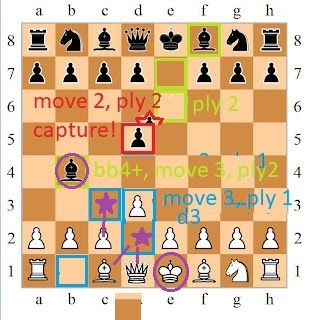 |
| fig. 1. Three Moves to get King out of Check |
White has to decide how to get their king out of check. A bad way would be to advance the queen, or the move "WhiteTurn.qd2!" Moving the bishop with "WhiteTurn.bd2!" is at least a little better, with the possibility of an even trade. Finally white can advance the bishop's pawn "WhiteTurn.c3!", which can also lead to a good trade, as well as forcing the bishop to move.
WhiteTurn.[ qd2!, bd2!, c3! ][a1-ap].[ support!, oppose! ] => RelieveCheck
fig. 2. Expression for all possible Moves and piece (agent) "voting"
Let's say the queen "dislikes" sacrificing herself to get out of check. Let's further say that the bishop "likes" the idea of the pawn moving forward. We could try denoting the using immunomemetic notation.
We can think of these as "virtual states" or "hidden states" in that the system does not really "stop" on them and we don't really need to name them explicitly. They are handled by immunomemetic notation. How this can act as a memetic nexus is as follows. Those pieces that are "listening" to the queen (4) can assume that other pieces are listening to the queen as well, and so if they throw their weight behind her "disliking" the "queen sacrifice" move, there will be a lot of support for the move, and that the move will succeed. In other words, they gamble a certain amount of memetic debt, or open a memetic loop, being fairly comfortable that they will get that memetic investment back (3).
First off, the "MoveChoice" state is a compelled state that the system goes into when all of the "like!/dislike!" and "support!/oppose!" deployments have been made, and some selection method determines which move is actually made (8). Let's look at figs. 4a1. and 4a2. The difference is that some agent "recommends" a course of action (memetic deployment) prior to other agents having the opportunity to deploy their memes. We see this in the state transition diagram.
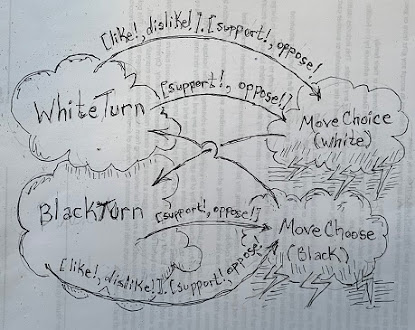 |
| fig. 5. State Diagram showing nexus-supported and unsupported transitions |
The idea is that we have two parallel memetic pathways, one involving a "like!" or "dislike!" before and the other not. In the figs. 4a., 4b., and 4d2, we can almost see "move!nexus.dislike![ nexus subscription cohort ].oppose!". In other words, we may have found our embedded notation for memetic nexuses, that is, the agents (cohort) who are subscribed to the nexus are indicated in the deployment descriptor, if the individual agent "decides to deploy" the given meme being supported by the nexus.
One thing to note, too, in fig. 4d2., is that all of the pawns are complaining about the pawn being thrown into harm's way. They all protest. In the case of the bishop or the queen, one player is making a case for or against, only one voice being raised, and the others deciding, guessing, whether there's enough charisma to get the measure through or not. In the pawns' case, an onlooker knows how many people are likely to vote for it, since they all complained, deployed a "dislike!". In other words, in fig. 4d2 it's "the mob" and in figs. 4b and 4c, it's the charismatic leader, the demagogue if you will. I will write up one or two ways to actually model this programmatically in the appendix.
One takeaway is that the meme "agent.support!" is much more "uncertain" than "nexus.like!agent.support!". In the former the agent is taking a wild guess as to whether anybody else will support it, and risking losing the bet and accruing residual memetic debt (the worst outcome for a memetic agent). On the other hand, if the nexus has deployed a polarizing message, then there is a chance that others will rally to the cause, especially if the cohort is large and loyal. Finally, we may be able to enbed the cohort membership in the deployment descriptor in the form of the "list" following the meme deployment following the "like!" or "dislike!". It remains to be seen how well this will work. It's important to remember that these are two different memes, so the perceptions of risks and rewards and even if a given agent considers one or the other to even be in his memetic inventory, are all potentially different.
Implications for Alliances
With the immunomemetic-style notation, we see how it applies to alliances and now to nexuses. The syntax is very much the same, if not identical. We may not need a separate treatment for alliances in this essay. More may be revealed later, but for now let's look at what we have. For instance, the queen "suggesting" a given move, she is acting as an ally to all of her members (and those who may not be members but who join in on an ad hoc basis (6)).
Conclusion & Summary
First, it's possible to model a nexus behavior using immunomemetic-style deployment descriptors. Further, it may be possible to embed the nexus subscribing cohort in the deployment descriptor, perhaps in a useful way.
The notation has led us to an interesting relationship between nexuses and alliances, and so may give use a clear idea of how to define, represent, and masure power. As memetic engineers, out goal is exact and relevant measurement, and the application of laws of a quantitative science in order to create (or consoliate) power where it does not exist, or to dismantle it where it does and is being misued, and all without bloodshed, unlike with practically all major power transitions in history.
Further Research
One area is the loss/gain of status of agents, nexuses, and agents who follow them. This is both whether a meme is chosen for deployment (residual memetic debt). Also there is how well the game is going. How might it work to give all agents a kick (+1 points) if they bet on a successful deployment (or anti-recommendation), and each agent also have a kick up or down if they supported it based on another piece's recommendation. The power of a memetic nexus (or mentor) ultimately stems from how many others continue to follow their deployments.
How useful is our representation of memetic nexus cohorts in immunomementic deployment descriptors? Will it prove unwieldy? Is it easy to read and understand?
Can we look at historical checkmates and back-propagate them in order to train and analyse.
Competition of two societies (opposite colors on the board). For example, central control by queen (or other) versus more democracy, or uncooperative pawns, and so forth.
How can the system "learn" without having to add a lot of notation and behind-the-scenes stuff? Can a memetic nexus lose currency, or the perceived value of their recommendations?
Also, once we have a microcosm going, how can we begin to use it to model real life situations? How to identify these first test groups?
________________
Bibliography
________________
Appendix
Concrete Models of Nexus-Based Deployments
All possible moves are the memes, but there are only a few moves per turn, and some might be absurd (whether we can judge that at this point is unclear). The first order of business is working out which move gets run. It's arbitrary, and a number of methods could be suggested.
One. The point value of each piece is applied against the "oppose!" or "support!" memes, add them up as I suggest in the previous essay. Another would simply be to count the number of deployments, one piece, one vote.
The next thing, once the memes are selected, is to list the winners and the losers and decide how to reward or punish them. This is a memetic loop, residual memetic debt kind of concept. Each piece makes an investment, a bet, and if they win or lose (based on the previous considerations), what happens? This could be thought of as the "selection function" in genetic algorithm design.
With a memetic nexus, it's a mix of things. If you have a setback, it might not always be easy to say for certain that it was your faith in your memetic nexus' memes that was the culprit. Plus, there tends to be a lot of collateral emotional investment (which is probably directly related to residual memetic debt, by th way), but that' shouldn't be an issue in our early stages here.
At the end of the day, it comes down to the difference between the likelihood of deploying "agent.meme!" and "nexus.bias!agent.meme!". If the agent sees no great difference in the risk reward of these two memes, then his faith in the nexus has either not developed yet or has collapsed under the weight of a series of failures (7).
How do we model this?
One simple way is that if a given piece consistently gets her suggestions passed is attractive.
________________
Footnotes
(1) Memetic nexus refers to a central agent connected to a collection of other agents via a "short jump" wherein the cental agent pumps out memes to all of them simultaneously. I have not yet put together a good notational description for this, but I think the same immunomemetic notation may serve well.
(2) An alliance is a configuration where a benefactor (or mentor) deploys memes which enable a beneficiary (or protegee) to deploy memes they would not otherwise be able to do (score a goal, secure a job interview, etc.). I use the same notation for alliance interactions as for immunomemetic exchanges. This makes a certain sense since immunomemetic memes and alliance memes alike serve to modify the effect of one meme to produce a different state from the one "intended." For example, "State1.protegee.run-downfield!mentor.pass-ball! => PassComplete" or "State2.mentor.block!protegee.score! => MadeGoal" or "State3.agent.try!enemy.block! => Blocked!"
(3) Memetic debt is "incurred" by deploying a meme, which opens a memetic loop. The loop is closed when the expected resonance to the deployed meme actually happens, for example, the group decision one supported is taken, the audience laughs at one's joke, and so on. An open question is whether there is additional memetic reward associated with the resonance success. This is almost certainly true, and needs to be accounted for, and this is going to be critical to quantitative memetic engineering down the track. For now we make arbitrary decisions in our model. There is also the idea of an agent losing status, so the weight of their liking/disliking and even the success of a group deployment diminishes (or grows).
(4) One aspect of a memetic nexus which is not contained by this simple notation is the idea of agents "subscribing" to the nexus. All we see is that the queen "likes" something, and this potentially influences the choices of the other agents. This isn't like an ally, where a new state is created (potentally a hidden one) that enables the protegee or benefactor to get to a new state that would be impossible otherwise. This nexus notation (which is the same notation) just expresses that a meme was deployed by the center of the nexus, but does not tell us which agents are going to respond. This would be some behind-the-scenes matrix or such, possibly with weights, possibly with each agent having some kind of internal state, possibly resembling a memeplex itself. Anyway, what we want is that if the queen (or the bishop) deploys a "like!/dislike!" meme, it signals that the following memes in the deployment descriptor might be a better-than-average choice. Another factor is feedback as to the record of successes garnered by subscribing to a given nexus. If it continues to go well, it might become more and more attractive somehow, which is what we would expect from our model.
(5) This final move selection method may be highly contrived for now. I may write up some ideas in the appendix.
(6) I have never stipulated that a memetic nexus cohort has to be a definite list, or that it cannot be fluid. The key feature is that agents who consume the nexus' memes and then use them with other members of the nexus are effectively members. If the queen recommends a move, she is doing the same thing, that is, making a given meme appealing for a large number of agents. So we see through this new notation for nexuses that alliances and nexuses are potentially very similar, if not identical, and so their both having a relationship to the memetic definition of power may be vendicated.
(7) What about an agent's overall assesment of how the game is going, and linking that to the performance of nexuses. Some kind of more sophisticated approach would be needed, but what? It may be pretty arbitrary. We're looking for group behavior coming from following of simple memetic rules and a clear notation to discuss then. It may well be that pieces could have their own, different criteria for how well it's going. Crazy example: the pawns, in addtion to tracking successful deployment decisions, could also worry about how many pawns have been killed off over time. For instance, if they're followed the queen's advice for a series of moves, the moves have been accepted (closing memeic loops), but half the pawns have been captured over that time, and they don't like that, so they start to ignore the queen.
Introduction
I've already laid out some notation for how to represent a chess board as a memetic society with 32 citizens and a very large number of clearly defined states and clear ways for describing and denotating them (4).
I'd like to explore the idea of how the board progresses from state to state, that is, how does each subcohort (the white and the black) decide which move to make next? I've proposed looking at it from the standpoint of a deployment decision competition among the various players on a given side who are actually able to move. If we go back to the laws of macromemetics, in particular the second, we can imagine memetic exchanges, like pieces could "holler" and "whisper" to each other (1,2), helping them to arrive at a next move.
What about memetic nexuses, alliances, immunomemes, and maybe even the three-narrative model?
Group Selection of Deployments
Let's look at a notation that tries to depict each piece (agent) being able to "support!", "oppose!", or "demur!" (17) any move that could be made at the given board state. We ultimately want to include ideas such as:
a. the "strength" of a given piece (9) adding weight to its support or opposition to a move
b. a piece's "prestige" going up or down based on whether a move "succeeds"
c. the long-term consequences of support (or opposed) moves impacting a piece's "prestige" (16)
We want to include the concepts of memetic debt, alliances, and memetic nexuses. These would probably include something like messages (memes) passed between pieces, to induce them to support one idea or another, with the promise of (memetic) reward. We then treat all the memes for the non-moving pieces like immunomemes, which may either "support!", "oppose!", or "demur!". In a general expression where there are agents (a) 1 through p, and memes (moves) 1 through n. The asterisk (*) denotes restriction to pieces and moves which are available at the given board state.
WhiteTurn.[ [ a1-ap ]*.[ m1!-mn! ]* ].[ [ a1-ap ].[ oppose!, demur!, support! ]
fig. 1. Expression for Deployment and Public Reaction
Here things start to look more like an immunomemetic expression, which also looks like an alliance behavior. We can start with all of the possible opening moves, without the immunomemes at first, to see what they look like. Again, here's the notation for all the spaces and moves on the board, and I've noted the names of the twelve possible opening moves.
 |
| fig. 2a. Annotated Chess Board and all Opening Moves |
Note that I'm using all lowercase for the chess algebraic notation, since I want to show them as agents, not states (7). In other words, not "Nb1" or "Nc3" but "nb1" and "nc3".
fig. 2b. All Opening Moves, Each Piece as Its Own Agent
Now we can try adding the immunomemes that determine whether each move actually happens (11). Each piece (agent) gets to deploy one meme in response to one move, or even no meme at all (12). Note that all agents
These approval memes are effectively asynchronous, that is, they can all be happening all at once, while the actual move is synchronous, only able to happen once all the dust has settled (13). We need some kind of way of selecting which move happens, for the sake of this model.
A Gigantic Quantity of States
The number of configurations for a chess board is enormous. It may be on the order of a google, or a billion trillion googles (10120).
In state transition matrix (agents by available memes), we see the opening move (18) like this, with two possible moves for each pawn and two for each knight. To save space, we'll denote the pawn moves as +1 and +2, instead of a3, a4, b3, b4, etc. We could devise a similar notation for the knights, e.g., north-right, north-left, with east, west, and south being impossible on the first move.
| memes! / agents |
+1 | +2 | na3 | nc3 | nf3 | nh3 |
| a2 | S1 | S2 | ||||
| b2 | S3 | S4 | ||||
| c2 | S5 | S6 | ||||
| d2 | S7 | S8 | ||||
| e2 | S9 | S10 | ||||
| f2 | S11 | S12 | ||||
| g2 | S13 | S14 | ||||
| h2 | S15 | S16 | ||||
| nb1 | S17 | S18 | ||||
| ng1 | S19 | S20 |
fig. 2a. Transition Matrix for Opening Chess Moves
Each transition leads to a new state, which in turn has transitions (moves) to other states. Clearly, we'd require a google of these state transition matrices needed to describe all possible options for all possible games. However, there is a commonality between transition matrices and deployment descriptors, so we could describe the following game by the following string of deployments (memes).
 |
| fig. 2b. A simple game opening |
 |
| fig. 2d. Next Move: Bishop Checks King |
The notation we've developed so far may be enough to support a useful model. The following is just an example.
Pieces all have point values: pawn = 1, knight / bishop = 3, rook = 5, queen = 9, king = ∞. Just for instance, we can use these values to weight the support or non-support of a given piece for a given action. In a deployment situation, for example:
WhiteTurn.nc3![ q, [a-c]2, bc ].oppose![ ra, [g-h]2 ].support! => WhiteTurn
queen:9 + (pawn x 3):3 + bishop:3 = 15 "opposed"
rook:5 + (pawn x 2):2 = 7 "support"
WhiteTurn.b2.b3![ b2, bc3 ].support! => BlackTurn
pawn:1 + bishop:3 = 4
fig. A1a. Knight move defeated, pawn move supported
A move may be thus defeated, but are we still left with the possibility of ties? There are eight pawns, four knights and bishops for 12 points, 10 points worth of rooks, and a queen worth 9. It's unclear how or if the king should vote (one point? tiebreaker?). We could say, for the sake of argument, that however many moves are approved, the highest-scoring one wins (counting support less opposition) and the king breaks ties. If nobody pushes for a move, or they all get shot down, then the king picks one.
Clearly. this is a very contrived example, something suitable for a programmatic implementation, for example. In this simple example there is no learning, and there is no possibility for alliances (how might we add this?). A piece (agent) who takes part of a successful memetic deployment, that is, votes to support it or oppose it, needs to get or lose points, which makes his power, his memetic currency greater or lesser in future votes. This is also unimplemented in our simple example.
One possibly fruitful direction is the concept of "ostentation as (ostensible) memetic currency," or some kind of display, like finery and ostentation (among birds and humans) as a signal of memetic power (follow me and you'll do well).
_______________________
Appendix
_____________
Until now I have maintained that a MIAO is more of a concrete object, to which memetic deployment opportunities attach, but this doesn't translate into useable notation. It occurs to me that a MIAO, implemented as a meme, acts in a kind of alliance-forming way. For example, the US Flag is an icon, and apple pie is iconic, but less so if by itself. The Statue of Liberty is a symbol both of emigration and of American patriotism which even xenophobes freely and non-ironically embrace. The 4th of July is America's National Day. So we have memes like "july4th!", "pie!(apple)" (as opposed to "pie!(pumpkin)" or "pie!(cherry)"), "statue-of-liberty!", "us-flag". Here we see how the icon, or the MIAO, of the 4th of July ("july4th!") strengthens the other memes or changes their meaning. July 4th makes apple pie prevalent over other pies, and the Statue of Liberty is about patriotism more than emigration.
fig. A2. MIAO-like influence of US icons on other memes
So what does this have to do with chess as a memeplex?
_________________
Bibliography
_________________
Footnotes
(1) To continue with this whimsical example, a knight who's able to jump to a position affording a better control of the center might "call out" to the other pieces something like "I'm keen to move" which could cause a transfer to a different state where the other pieces are less inclined to move themselves.
(2) This is perhaps similar to my "See-and-Say Steering Wheel" proposal. I'll probably write a whole piece about this elsewhere. The point is that traffic road rage is theoretically exacerbated by the lack of memetic inventory available for drivers to communicate (exchange memes) with one another. The simple expedient of adding a few more horn sounds (3)
(3) The See-and-Say horn sounds should be iconic, and with an even distribution of "positive" and "negative" ones. For instance, cat meowing, dog barking, farting, cow mooing, rooster crowing, and so forth. Some of these sounds might be considered "aggressive," or "mocking," while others are friendlier. Actually, this is all theoretical. Research needs to be done as to how many horn sounds would be optimal, or even minimal, and which ones "work best," and what that might mean. The hope is that some of these kinds of questions might be illuminated by the chess model, how pieces might "talk to" each other in order to arrive at a move decision.
(4) I'm interested in some kind of "many worlds" model of the progression of the board. It might be useful for developing some kind of genetic (memetic) algorithm for refining the behavior of the system, which might include immunomemetic systems (5).
(5) What role do immunomemes play in the chess system? How about alliances? These are really important questions since I've been developing these things lately, so they should fit into any meaningful model of anything. Another thing to consider is memetic nexuses. All of these things should figure strongly in a miniature model of society and help it to function.
(6) Each piece makes its own "recommendation" for what the next move should be.
(7) agents and memes are denoted by hyphenated lowercase, memes with an exclamation mark after. States are CamelCaps, with underbars if needed.
(8) Using lowercase for chess pieces is unambiguous except for the bishops, so it should work.
(9) I think I need a term for this, perhaps "memetic karma" or "memetic currency." Agents see other agents as favoring one or another deployment, and depending upon their "status" those deployments are seen as more or less favorable. Are these two quantities related, the same thing, totally separate? At this point we're starting to put together an artificial model. "Status" may be something between each agent, or perhaps an agent has "global status." The minions of a kingmaker may perceive said kingmaker more highly than random people. The agent who fails in deployment face-offs may also lose self-confidence in addition to the (social) confidence.
(10) "Evil triumphs when brave men do nothing." This happens when there is no other meme to be deployed with hope of success. Even if there seems to be no valuable effect, deploying something as a collective and not in step with a bad movement can perhaps be valuable.
(11) We assume that each player "voting" only gets one vote, that is, in favor, opposition, or tacit acceptance, of only one possible move. This is just a simplifying choice, however. One can easily imagine agents supporting multiple possible outcomes in one form or another.
(12) Again, deploying no meme at all may be a physiological impossibility. That is, if somebody deploys a meme that you recognize, then by definition you must react, even if it's to take no outwardly discernable action, or even recognize it at a "conscious" level. For example, you always recognize words and sentences in your native language--they just jump right into your head, fully formed, without a lot of "conscious" pre-processing. In our modeling, it's probably useful to simplify and posit that it's possible for an agent to not react at all to a given move, or to any moves.
(13) One can imagine memes being passed back and forth, publicly or between individuals, to control the way they deploy their memes. Something like "canvas!" or "prompt!" or "pitch!" or "query!" (like a subscriber to a nexus asking which meme to deploy). We may be able to integrate this later.
(14) Immunomemetic notation refers to stacking memes up. This effectively "hides" a state (15). This works for alliances, "agent.attempt!ally.help!agent.succeeds!" or "ally.set-up!agent.success!". Immunomenes work to block other memes. Meme deployments, by definition, cause state transitions, and immunomemes prevent such changes, or redirect the system to "safe" states. For instance, while with "State1.agent.attempt! => State2", agent gets what she wants, but with "State1.agent.attempt!enemy.block! => State1" has an enemy sending the system back to State1. But again, by definition, there is a state that "attempt!" sends the system to, and then "block!" sends it back, but we don't bother to name this "virtual state."
(15) There are three kinds of "hidden state," but the idea is the same. The system does not stop in the hidden state (or "virtual state" or "compelled state") and one is obliged to immedaitely deploy a meme to get to another state, and the choices of states and memes are limited. One truism is "agents hate compelled states." And example of a compelled state where the agent is hurled into one of two states depending on environmental circumstances (what the kids are up to when the parent barges in, which they don't a priori know). The concept of a "compelled state" first appears in my first Dining Philosopher's essay. If a state does not compel an agent to another state (in an undesirable way), or there are interesting transactions that take place but are hidden in a "black box", then a "virtual state" is a neutral term. This sort of thing happens when an immunomeme is deployed to block the effects of a deployed meme, and the system goes back to where it was or to a different state. We don't really care about, to give a name to, the state that exists between the deployment of a meme and it's defeat at the hand of an immunomeme. This looks like "State1.agent1.meme!agent2.immunomeme! => State1" There's a state between the deployment of the two memes, obvious, but there are no deployment choices there, and except for maybe an "awkward pause," nothing interesting happens in that state, so we might call it a "virtual state."
(16) A piece becoming more prestigious based on whether the moves it supports actually getting made and the positive or negative impact said moves have on the game. The latter is a complex question. Any number of algorithms, such as back-propagation from when a valuable piece is captured, or when an enemy (or friendly) king is checked. This will probably be "behind the scenes" to the notation we'll build in this essay. The simplest case is random, possibly using piece "points" as "status" values, and no change in status over time.
(17) The "demur!" meme doesn't really do much, that is, agents deploying it or not makes no difference. However, a piece can deploy it against themselves, that is, they don't "oppose!" or support" their own move. For instance, the queen's knight opener, "WhiteTurn.nb1.na3!" (or just "na3!") lacks an immunomemetic term, so we don't know if we can evaluate whether any other agents support or oppose, even the knight itself. If we put "na3!nb1.demur!" we know that it's an immunomemetic expression. If we hold that a move cannot be made until the support or opposition can be evaluated, then this notational convention helps.
